First-Aid Certification Course in Pune: Admissions Open,
Every year, thousands of workplace injuries in India turn fatal simply because no one nearby knew what to do in the first three minutes. A First-Aid Certification isn’t just a resume line — it’s the difference between panic and control when someone’s life is on the line. If you’ve been putting off learning this skill because you think you need a medical background, here’s the good news: you don’t. ISTRO’s First-Aid Certification Programme is open for enrollment, and it’s built for absolute beginners.
Why First Aid Is No Longer Optional
Workplace safety regulations across India increasingly expect at least one certified first-aider per floor or shift — not just in factories, but in offices, retail stores, schools, and hospitality units. The Factories Act and various state Shops & Establishment rules already push in this direction, and companies inspected for compliance are asked to show proof of trained personnel.
The real-world cost of not knowing first aid
- Cardiac arrest survival rates drop by roughly 10% for every minute CPR is delayed — most ambulances in Indian cities take 15–20 minutes to arrive in traffic.
- A large share of workplace fatalities in industrial settings are linked to delayed first response, not the severity of the injury itself.
- Choking, burns, and minor fractures — the most common workplace incidents — are also the most treatable, if someone nearby knows what to do.
Who actually needs this certification
- HR and admin staff responsible for employee welfare
- Factory floor supervisors and shift leads
- Teachers, daycare and school staff
- Retail and hospitality frontline employees
- Anyone preparing for a safety officer or EHS career
What Makes ISTRO’s First-Aid Programme Different
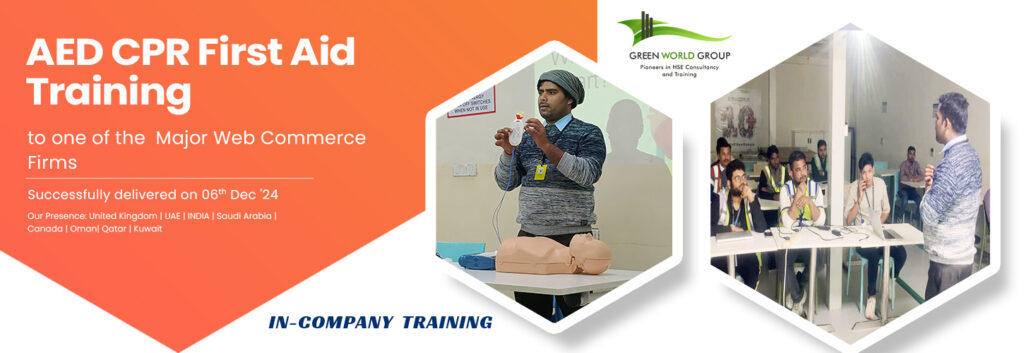
Not all first-aid courses are built the same. Many rely on slideshows and a written test. ISTRO’s approach is scenario-based — you don’t just learn what CPR is, you practice it on a manikin until your muscle memory takes over.
Hands-on, not just theory
Every module pairs a concept with a physical drill: bandaging techniques are practiced on a partner, CPR is timed and corrected in real time, and choking response is rehearsed until it’s instinctive.
Trainers with real emergency experience
Sessions are led by trainers with direct exposure to industrial and emergency response settings — not just textbook facilitators. That matters when a student asks “what if the person is also bleeding?” and needs a real answer, not a scripted one.
Certification that’s recognized where it counts
Graduates receive a certificate that can be presented to employers, compliance auditors, and — depending on your career track — used as a credential when applying for safety officer or EHS roles.
Who Should Enroll — and Why “Beginners Welcome” Actually Means It
A lot of people assume first-aid training is for nurses, doctors, or people already working in safety roles. That assumption keeps far too many people from signing up.
No prior medical knowledge required
The course starts from zero — how the body responds to injury, why certain steps matter, and only then moves into technique. If you’ve never taken a pulse in your life, you’re the exact person this course is designed for.
Ideal for career switchers
Fire and industrial safety is a growing field in India, and a first-aid certification is often the first credential people add before moving into broader EHS or safety officer training. It’s a low-commitment way to test whether the field is right for you.
Useful even if you never use it professionally
Parents, caregivers, and anyone who simply wants to feel less helpless in an emergency benefit just as much as working professionals. This isn’t only a corporate compliance checkbox — it’s a life skill.
What You’ll Actually Learn in the Programme
Understanding the syllabus upfront helps you know exactly what you’re signing up for.
Core emergency response skills
- CPR and AED basics
- Choking response (adults and children)
- Bleeding control and wound care
- Burn treatment (thermal, chemical, electrical)
- Fracture and sprain stabilization
Workplace-specific scenarios
- Responding to fainting or heat exhaustion on a factory floor
- Managing chemical exposure incidents
- Handling electrical shock cases safely
- Coordinating with emergency services during a workplace incident
Soft skills that matter under pressure
Staying calm, communicating clearly with panicked bystanders, and making fast triage decisions are taught alongside the technical skills — because knowing the right steps means nothing if panic gets in the way first.
How This Fits Into a Bigger Safety Career Path
First aid is rarely a standalone credential for people serious about the safety field — it’s usually step one. Many ISTRO learners go on to combine it with Fire Fighting, EHS, or Behaviour-Based Safety training to build a fuller safety officer profile. If you’re evaluating this as a career direction rather than a one-time skill, ask about combo course options when you enroll.
Ready to Get Certified?
Emergencies don’t wait for the “right time” to learn how to handle them — and neither should you. Whether you’re securing your workplace’s compliance requirements or simply want the confidence to act when it matters most, ISTRO’s First-Aid Certification Programme gives you practical, hands-on skills in a beginner-friendly environment.
Seats are open for the upcoming batch. [Enroll now / Contact ISTRO] to reserve your spot — no medical background required, just the willingness to learn.
