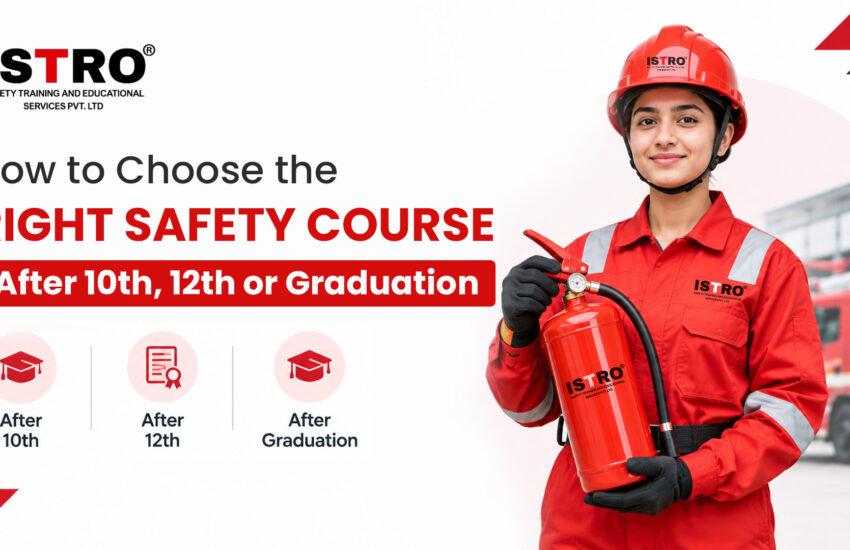
How to Choose the Right Safety Course
Choosing the right career path after 10th, 12th, or graduation can feel overwhelming. With so many professional courses available today, students often look for programs that can help them develop practical skills and create opportunities across different industries.
One such career option is Safety and EHS (Environment, Health & Safety).
Industries such as manufacturing, construction, infrastructure, oil and gas, logistics, hospitality, healthcare, and other workplaces require trained professionals who can identify hazards, support emergency preparedness, conduct safety inspections, and promote safer working practices.
But which safety course is right for you?
The answer depends on your educational qualification, career goals, interests, and the type of safety role you want to pursue.
In this guide, we explain how to choose a safety course after 10th, 12th, or graduation.
Why Choose a Career in Safety and EHS?
Safety is an essential part of every workplace where people, equipment, materials, or processes can create potential risks.
A safety professional may be involved in activities such as:
- Identifying workplace hazards
- Conducting safety inspections
- Supporting emergency preparedness
- Fire prevention and protection
- First-aid and emergency response
- Safety training and awareness
- Incident reporting and investigation
- Risk assessment
- Workplace health and safety monitoring
As industries become more focused on workplace safety and compliance, trained safety professionals can find opportunities across multiple sectors.
How to Choose a Safety Course After 10th
After completing 10th, students may want to start developing practical skills while continuing their education.
At this stage, look for courses that provide a strong foundation in workplace safety and introduce you to areas such as fire safety, first aid, industrial safety, and emergency response.
What Should You Look For?
Before enrolling, check:
1. Course Eligibility
Make sure your educational qualification meets the institute’s admission requirements.
2. Practical Training
Safety is not only theoretical. Look for programs that include practical demonstrations, scenarios, drills, and workplace-oriented learning.
3. Course Duration
Understand how long the program takes and whether it fits your education and career plans.
4. Certification
Check who issues the certificate and whether the course is associated with recognized universities, institutions, or industry bodies.
5. Career Path
Choose a course that can help you understand the next steps in your safety education rather than selecting a program only because it is short-term.
Who Can Consider This Path?
Students who are interested in:
- Fire safety
- Emergency response
- Workplace safety
- First aid
- Industrial environments
- Practical, field-oriented careers
can explore safety education after 10th, depending on the course eligibility criteria.
How to Choose a Safety Course After 12th
After 12th, students have more options when selecting a professional safety program.
You can consider courses that provide deeper knowledge of Industrial Safety, Fire Safety, Occupational Health, First Aid, and EHS practices.
A good program should help you understand not just individual safety procedures but also how safety is managed within an organization.
Important Factors to Consider
1. Check the Course Curriculum
Don’t choose a course based only on its title.
Read the syllabus and check whether it covers topics such as:
- Workplace hazards
- Fire prevention and protection
- Risk assessment
- Emergency management
- Occupational health
- First aid
- Safety inspections
- Incident prevention
- Safety management systems
2. Look for Practical Exposure
Practical learning can make a significant difference in safety education.
Look for institutes that include activities such as:
- Fire drills
- Emergency response exercises
- First-aid demonstrations
- Hazard identification
- Safety inspections
- Scenario-based training
3. Understand the Qualification You Receive
Before admission, understand whether you are receiving a certificate, diploma, advanced diploma, or degree-related qualification.
Also check the awarding or affiliating organization.
4. Consider Your Long-Term Career Goal
Ask yourself:
Do I want to work primarily in fire safety?
Am I interested in industrial safety?
Do I want to build a career in EHS?
Am I interested in occupational health and workplace emergency response?
Your answers can help you choose a course that matches your interests.
How to Choose a Safety Course After Graduation
Graduates may choose safety education to add a professional specialization to their existing academic background.
For example, graduates from technical, science, management, or other relevant backgrounds may explore EHS and safety-related programs depending on the eligibility criteria of the institute.
At this stage, consider programs that can help you develop knowledge in areas such as:
- Environmental Health & Safety
- Industrial Safety
- Occupational Health
- Fire Safety
- Risk Assessment
- Emergency Management
- Safety Auditing
- Incident Investigation
- Safety Management Systems
Why Does Your Graduation Background Matter?
Your existing academic background can influence the type of safety role you may eventually pursue.
For example, someone with a technical background may be interested in industrial or process safety, while another graduate may prefer workplace safety coordination, training, compliance, or EHS management.
Therefore, don’t select a course simply because it is popular. Look at how the course fits into your existing education and long-term career plan.
Safety Course vs Short-Term Safety Certification
Not every learner needs the same type of program.
A short-term certification may be suitable for someone looking to develop knowledge in a specific area, such as:
- First Aid
- Fire Safety
- Emergency Response
- Basic Workplace Safety
A diploma or advanced program may be more suitable for someone who wants broader knowledge and intends to build a longer-term career in safety or EHS.
Before enrolling, compare:
Course duration → Curriculum → Practical training → Certification → Eligibility → Career relevance
This simple checklist can help you make a more informed decision.
7 Things to Check Before Joining a Safety Course
Before paying the admission fee, ask the institute these questions:
1. What is the eligibility criteria?
Make sure your educational qualification matches the program.
2. What will I learn?
Ask for the complete course curriculum.
3. Is practical training included?
Find out whether the course includes drills, demonstrations, field activities, or scenario-based learning.
4. Who provides or awards the qualification?
Check the university, institution, or industry body associated with the program.
5. What are the next study options?
A good career plan should consider what you can study after completing the course.
6. What industries can I explore?
Understand where the skills gained from the program may be applicable.
7. Does the institute provide career guidance?
Training should ideally help you understand how your qualification connects with potential career paths.
Common Mistakes Students Should Avoid
Choosing a safety course only because it is short or inexpensive can create problems later.
Avoid these common mistakes:
❌ Choosing a course without checking eligibility
❌ Selecting a program without reading the syllabus
❌ Ignoring practical training
❌ Assuming every safety certificate has the same recognition
❌ Choosing a course only because someone else recommended it
❌ Not checking the institution or affiliating body
❌ Focusing only on the certificate instead of the skills you will develop
Your safety education should be selected based on your career objective, educational background, and learning requirements.
Which Safety Course Is Right for You?
There is no single safety course that is suitable for everyone.
Your starting point matters.
| Your Qualification | What You Can Explore |
|---|---|
| After 10th | Foundation-level safety and skill-based programs, subject to eligibility |
| After 12th | Diploma/advanced safety and specialized programs, subject to eligibility |
| After Graduation | Advanced safety, EHS, occupational health, and specialized programs |
The right choice depends on your qualification, interests, preferred industry, and long-term career plans.
Build Your Career with the Right Safety Education
A career in safety is built on more than a certificate. It requires knowledge, practical skills, awareness, discipline, and the ability to respond appropriately to workplace hazards and emergencies.
Whether you are completing 10th, 12th, or graduation, take time to compare the course curriculum, practical exposure, qualification, eligibility, and career pathway before making your decision.
If you are interested in building your knowledge in Fire Safety, Industrial Safety, Occupational Health, and First Aid, explore the safety education programs offered by ISTRO – a division of PARS Techso India Pvt. Ltd.
Choose your course based on where you want your career to go—not simply where you can start.
Explore ISTRO’s safety courses and take the next step toward a career in workplace safety and EHS.
